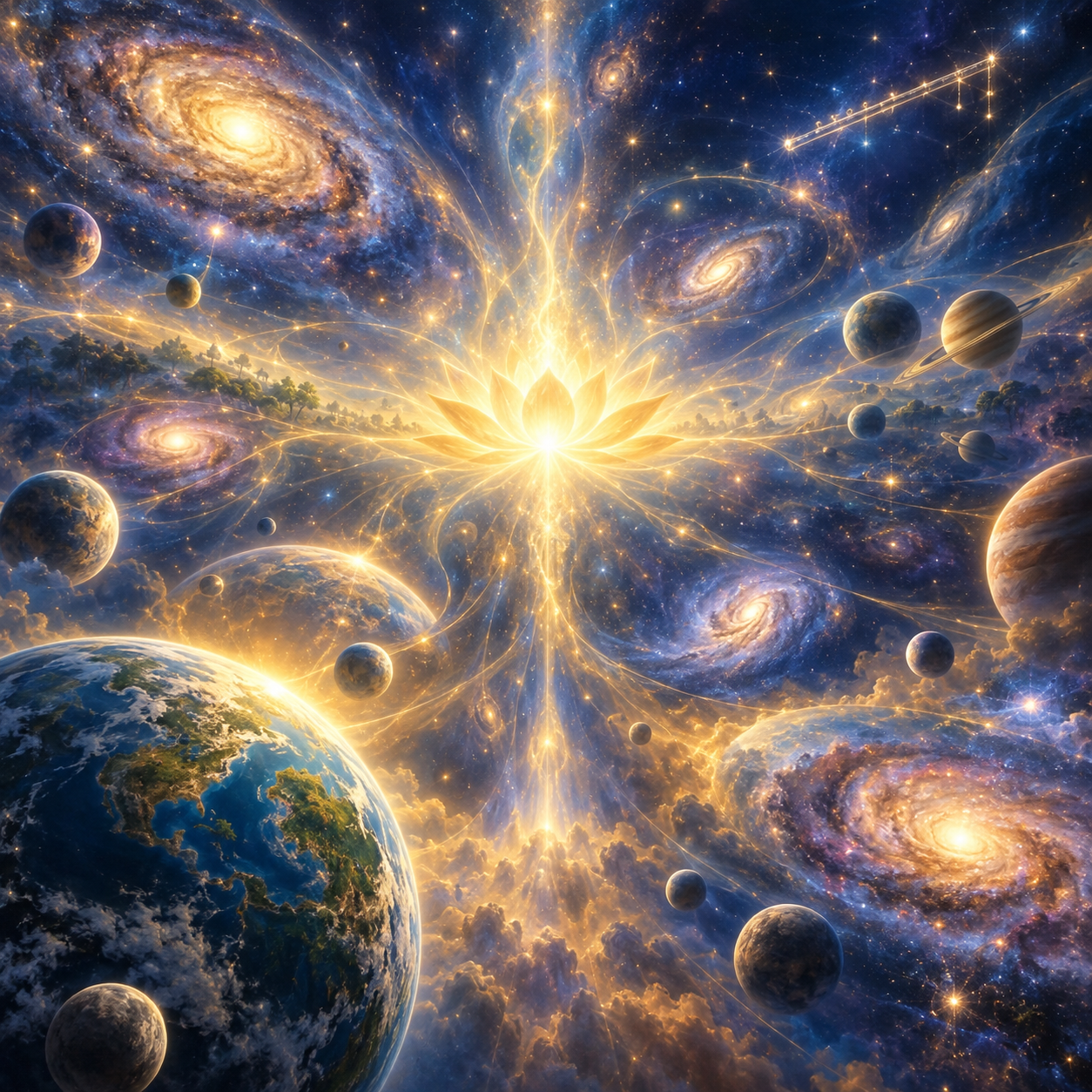
The Presence That Sustains Everything: Recognizing Krishna Within and Beyond the World
Krishna pervades the universe without being limited by it: learning to perceive His energies, distinguish the self from the mind, and rediscover our eternal identity in service.
Reflections from the online satsang with Gauranga Sundara Prabhu – Bhagavad Gita 9.4
Hare Krishna 🙏
How can Krishna be present everywhere and yet not be contained in the things we see? In the satsang of Wednesday, September 9, centered on Bhagavad Gita 9.4, Gauranga Sundara Prabhu led us into this apparent paradox. The answer does not remain on the level of philosophy. It changes the way we look at nature, the body, the mind, pleasure, time, and even our most ordinary actions.
The class invites us to recognize a presence that sustains everything without being subjected to what it sustains. Krishna is near as Paramātmā in the heart of every living being and within every atom; He can be perceived through His energies; and yet He always remains the transcendent Lord, never controlled by matter. To understand this is not simply to collect information. It requires relationship, service, and a heart willing to be transformed.
Bhagavad Gita 9.4: The Lord Pervades the Entire Universe
mayā tatam idaṁ sarvaṁ
jagad avyakta-mūrtinā
mat-sthāni sarva-bhūtāni
na cāhaṁ teṣv avasthitaḥ
Krishna declares, “By Me, in My unmanifested form, this entire universe is pervaded. All beings are in Me, but I am not in them.” The expression avyakta-mūrtinā points to His form unmanifest to material senses. We may not see the Divine Person with ordinary eyes, but we can learn to recognize the workings of His energies and become receptive to His presence.
Gauranga Sundara Prabhu reminded us that Krishna does not appear in response to the mundane demand, “If God exists, show me God.” Spiritual vision is not produced by command but by inner qualification. Krishna explains why He can reveal this knowledge to Arjuna: Arjuna is His devotee and His friend. Devotion and relationship open the jar of honey. Speculation from outside may describe its color and consistency, but only one who tastes it truly knows its sweetness.
Energy and Source: Nearness Without Confusion
Krishna’s energy is not separate from Him in the ordinary sense. As sunshine reveals the presence of the sun even when the solar globe is hidden behind clouds, creation manifests the intelligence and potency of its source. In the taste of water, the sweetness of food, warmth, light, and life itself, we can learn to remember Krishna.
The class distinguished several ways in which His presence may be understood. Krishna pervades everything through His external energy; He resides as Paramātmā, the Supersoul, in the heart of every being and even within every atom; and all existence rests upon the spiritual effulgence of Brahman. His internal energy, the hlādinī-śakti, is His pleasure-giving spiritual potency and makes the ecstasy of relationship with Him possible.
At the same time, Krishna is never touched or conditioned by matter. Srila Prabhupada explained separated energy with the example of a recorded lecture. Thousands of miles away, the recording carries Srila Prabhupada’s voice and message; he is present through his energy without being physically contained in the tape recorder. In the same way, the world depends upon Krishna and manifests His potency, but it cannot limit Him.
I Do Not “Have” a Soul—I Am the Soul
One especially striking part of the class concerned our own identity. At the beginning of spiritual life, it is already valuable to recognize something beyond the body and to say, “I have a soul.” Yet this remains an initial understanding. The śāstra, the revealed scriptures, lead us further: we do not possess a soul as we possess a house or a car. We are the soul, and we temporarily have a body.
Maharaja suggested a simple exercise. Before sleeping, when the body is still, we may observe what the mind produces: images, memories, emotions, fears, and desires. The mind is like a cinema screen. If I can watch the film, I must be different from the film. I may become so absorbed in the story that I laugh or cry, but I remain the one observing the projection.
This distinction does not make us indifferent to life. It frees us from automatic identification. The observing consciousness is the soul; Krishna is also within the heart as Paramātmā, witness and guide. The Upaniṣads give the image of two birds in the same tree: one tastes sweet and bitter fruits and becomes involved in their consequences; the other witnesses. When we identify with body, mind, possessions, and social roles, we claim our actions and inherit their karma. When Krishna returns to the center, action can become service and cease to generate fresh bondage.
The Need for a Shelter That Does Not Wear Out
Every living being seeks stability, just as a tender plant needs support so that the wind will not bend it to the ground. In the material world, however, everything is subject to kāla, time. The pleasure of taste lasts only while food touches the tongue. A new car loses value as soon as it leaves the dealership and continues to wear out. The body gathers wrinkles and difficulties, while inwardly we still feel ourselves to be the same person.
The class did not deny that material pleasure exists; it showed its unstable nature. When we ask the temporary to give us permanent shelter, frustration is inevitable. Stable shelter is found by fixing consciousness on Krishna’s lotus feet. Our relationship with Him is not worn down by time and gives our life a true center.
The Soul’s Eternal Nature Is Service
Gauranga Sundara Prabhu recalled the teaching jīvera svarūpa haya—nitya-kṛṣṇa-dāsa: the constitutional identity of every living being is to be Krishna’s eternal servant. Nitya means eternal, and dāsa means servant. This is not a role imposed from outside. It is the nature of the soul, just as heat and light belong to fire and wetness belongs to water.
A spark remains bright while it stays within the fire; separated from the fire, it becomes extinguished. Similarly, consciousness becomes fully alive through connection with Krishna. Srila Prabhupada also used the image of an iron rod placed in fire. It becomes red and glowing and acquires the qualities of fire while remaining iron. The devotee does not become the Supreme Creator, but through contact with Krishna spiritual qualities become manifest. We are one with Krishna in quality, never in quantity.
From Flickering Pleasure to a Higher Taste
Material impressions accumulated over many lives reach deep into the mind. The satsang returned to the image of a bamboo forest. Cutting or burning what appears above ground is not sufficient; the underground roots send up new shoots. Mere restraint leaves the seed of desire intact.
Bhakti works at the root. Hearing, chanting the holy name, honoring prasādam, and serving create spiritual saṁskāras—impressions that gradually displace material conditioning. Maharaja recalled the beggar holding a dry piece of stale bread. If we try to take it away, he will resist. If we offer him a fresh plate of prasādam, he will let it go freely. Attachment is not overcome merely by prohibition but by encountering a higher taste.
A vegetarian professor once admitted that each year he allowed himself to eat a favorite meat dish. External restraint had not removed the inner taste. By contrast, sincere practice of Krishna consciousness allows certain attractions to fade naturally. The Maha Mantra does not merely hold desire back; it purifies the heart and destroys its seed.
A Sound From Another World
One of the most personal stories in the class went back to Gauranga Sundara Prabhu’s teenage years. A devotee he met while shopping persuaded him, almost against his inclination, to accept a small record. On one side was Hansadutta Swami chanting; on the other, Himavati singing Tulasī Kṛṣṇa-preyasī. When he played it at home, he immediately felt that this was not ordinary sound. He listened again and again, day after day. The transcendental vibration had entered through the ears and reached the heart.
Later, he received Srila Prabhupada’s Bhagavad Gita. Reading it felt like drinking water directly from the source rather than several meters downstream. A long search through many books and ideas had found its center. The search for deeper realization of Krishna continued, but the wandering search for an undiluted truth had ended.
The Maha Mantra—Hare Krishna, Hare Krishna, Krishna Krishna, Hare Hare / Hare Rama, Hare Rama, Rama Rama, Hare Hare—is spiritual energy in sound. It may appear to be a vibration like any other, but it produces an effect in the heart that mundane sound cannot. Maharaja described Sri Chaitanya’s spreading of the holy name as a chain reaction: those who saw Him chant became spiritually ecstatic, and others were touched simply by seeing those devotees.
Questions on Doubt, Atheism, and Accountability
In the concluding discussion, one participant observed that the words “I am not in them” might seem to contradict Krishna’s presence in the heart. The response again showed the importance of Srila Prabhupada’s purports: Krishna is present and sustains everything, yet He is neither circumscribed nor contaminated by living beings or matter.
Another question concerned atheism. The class invited a careful response rather than a simplistic one. Some people reject God after seeing conflict and abuse performed in the name of religion. Others resist a higher authority because it implies accountability for their actions. Contempt is not the answer. Where there is some humility and sincere openness, knowledge, sound reasoning, and personal example can help. Where there is only a desire for confrontation, prolonged argument may be fruitless.
The distinction drawn between living spirituality and religion reduced to material interest deserves attention. Even an authentic tradition can become obscured when used for prestige, power, or personal advantage. Krishna consciousness brings us back to a pure relationship with the Supreme, genuine guidance, and the responsibility that comes from knowing that Paramātmā accompanies and witnesses every action.
Reviewed Discourse
A Personal Reflection
This class leaves me with two images: the cinema screen and the spark in the fire. So often I mistake the mind’s projection for my identity and am carried away by fears, memories, and desires as though they were final reality. To stop and observe reminds me that I am not that film. I am the soul who can turn toward Krishna, already present within the heart.
Yet observation alone is not enough. A spark away from the fire loses its light; consciousness away from relationship looks for supports destined to decay. The real movement is to remain in contact: to hear, chant, serve, receive guidance, and learn to recognize Krishna in the taste of water, in light, in every being, and in every opportunity for service. Then the world does not disappear, but it ceases to be a collection of objects to possess. It becomes the Lord’s energy, to be honored and returned to its source.
Bhagavad Gita 9.4 does not ask my finite mind to contain the Infinite. It asks me to live within the presence that already sustains every breath and to offer my heart to the One whom the universe cannot contain, yet who chooses to accompany every soul.
Hare Krishna 🙏
— Ramananda Das 🌿