Author name: HKC

Gauranga.org Articles, General News

Hinduism And Ecology – The Seeds Of Truth

  Balbir Mathur was born and raised in Prayaga, India, in a Hindu home. His father was in the army and he attended a British school where he was taught by Catholic missionaries. Like so many of his generation, he grew up with an inferiority complex about his mother culture. “I was led to believe … Read more

Bhagavad Gita, Gauranga.org Articles, Video

Seeds of Death

  In preparation of the global March Against Monsanto, you are invited to watch the award-winning documentary Seeds of Death.   March Against Monsanto   The leaders of Big Agriculture – Monsanto, DuPont, Syngenta – are determined that the world’s populations remain ignorant about the serious health and environmental risks of genetically modified crops and … Read more

Gauranga.org Articles, General News

Finding Sarasvati

  “O Ganga, Yamuna, Sarasvati, Sutlej, Ravi, follow my praise. O Chenab, Jhelum, with Haro and Sohan, listen” The above verse written over 5000 years ago comes from the Nadistuti Sukta portion of the Rigveda. In chronological order the Rigveda names the rivers which once formed the geography of the ancient Vedic civilisation. The British … Read more

Gauranga.org Articles, General News

Antony Flew – How An Atheist Changed His Mind

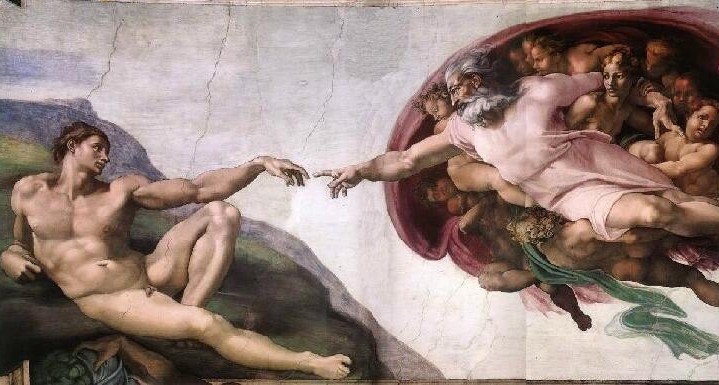
For the last half of the twentieth century, Antony Flew (1923-2010) was the world’s most famous atheist. Long before Richard Dawkins, Christopher Hitchens, and Sam Harris began taking swipes at religion, Flew was the preeminent spokesman for unbelief. However in 2004, he shocked the world by announcing he had come to believe in God. While never embracing Christianity, Flew only believed in the deistic, Aristotelian conception of God, he became one of the most high-profile and surprising atheist converts. In 2007, he recounted his conversion in a book titled “There is a God: How the World’s Most Notorious Atheist Changed His Mind”. Some critics suggested Flew’s mental capacity had declined and therefore we should question the credibility of his conversion. Others hailed Flew’s book as a legitimate and landmark publication.
A couple months before the book’s release, Flew sat down with Strange Notions contributor Dr. Benjamin Wiker for an interview about his book, his conversion, and the reasons that led him to God :
 
Dr. Benjamin Wiker : You say in your book “There is a God” that “it may well be that no one is as surprised as I am that my exploration of the Divine has after all these years turned from denial…to discovery.” Everyone else was certainly very surprised as well, perhaps all the more so since on our end, it seemed so sudden. But in your book “There is a God” we find it was actually a very gradual process, a “two decade migration” as you call it. God was the conclusion of a rather long argument, then. But wasn’t there a point in the “argument” where you found yourself suddenly surprised by the realization that “There is a God” after all? So that, in some sense, you really did “hear a Voice that says” in the evidence itself “‘Can you hear me now?’”
Antony Flew : There were two factors in particular that were decisive. One was my growing empathy with the insight of Einstein and other noted scientists that there had to be an intelligence behind the integrated complexity of the physical Universe. The second was my own insight that the integrated complexity of life itself, which is far more complex than the physical Universe, can only be explained in terms of an intelligent source. I believe that the origin of life and reproduction simply cannot be explained from a biological standpoint despite numerous efforts to do so. With every passing year, the more that was discovered about the richness and inherent intelligence of life, the less it seemed likely that a chemical soup could magically generate the genetic code. The difference between life and non-life, it became apparent to me, was ontological and not chemical. The best confirmation of this radical gulf is Richard Dawkins’ comical effort to argue in “The God Delusion” that the origin of life can be attributed to a “lucky chance.” If that’s the best argument you have, then the game is over. No, I did not hear a voice, it was the evidence itself that led me to this conclusion.

Gauranga.org Articles, General News

King Dasarathas Longing

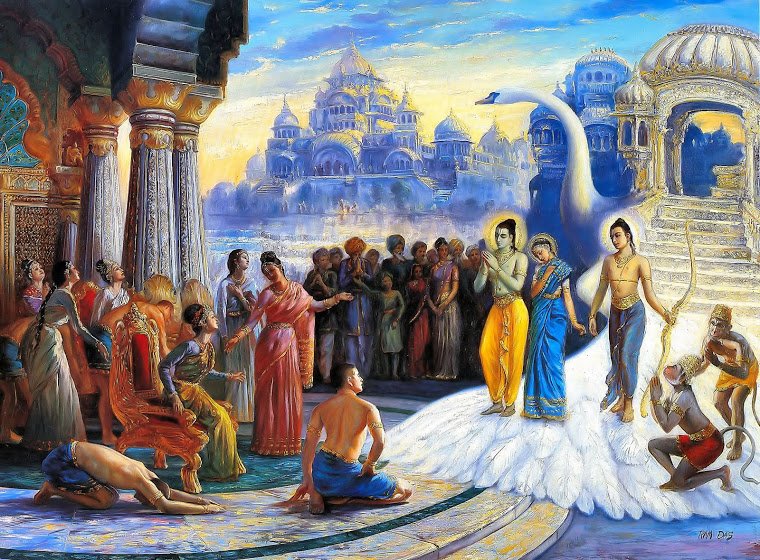
    King Dasaratha paced his palace balcony. His handsome brow was furrowed. In a pensive mood, he surveyed the scene around him. People thronged the inner courtyard below. Feudal kings and princes came with their retinues to pay tribute. From his seventh-story terrace Dasaratha could see much of his city, which stretched to the … Read more

Gauranga.org Articles, General News

Socrates and Hector Dawkins

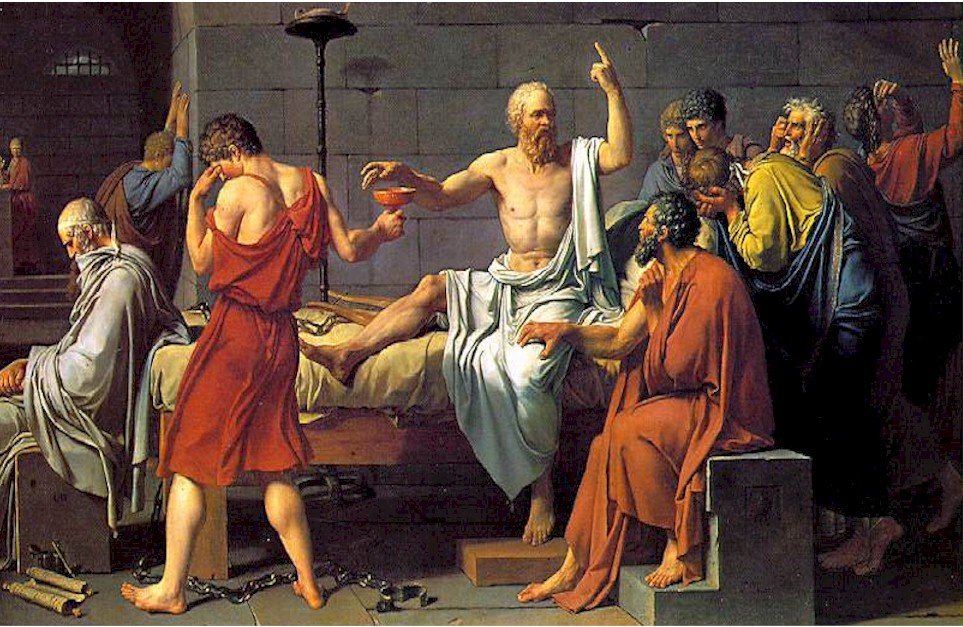
  On The Definition of Science: A debate between Socrates and Hector Dawkins By James Hoskins   As a fairly reasonable person, I am repeatedly astonished by dogmatists who voice their opinions on amoral issues so loudly and adamantly, that they seem to imply a moral indignation toward anyone who would disagree, thereby encouraging the … Read more

Bhagavad Gita, Gauranga.org Articles, General News

The Cherry On The Cake


I sat in my room in the temple building in Skopje, the capital of Macedonia, taking prasadam and listening to a bhajan by devotees downstairs in the temple itself. “That’s such a sweet bhajan” I said to a devotee “and it’s been going on for hours.” “Yes, Maharaja,” he said. “The Macedonians are very musically inclined, we love to sing and play musical instruments. We even have our own form of a tamboura here, a four-stringed instrument. Devotees use it often in bhajans.” Two hours later I left for the square in the city center with a group of twenty devotees. The square, renovated in recent years, is a popular place for the people of Skopje to spend warm summer evenings sitting, talking, and eating in nearby restaurants. As we approached the square I saw the huge statue of Alexander the Great.
“That statue is quite impressive,” I said to a devotee.
“Yes,” he replied. “Alexander the Great was from Macedonia. He left here to conquer the world, he built a huge empire, but it was too much to manage, and he never returned home.” I had been reading TKG’s Diary by Tamal Krsna Goswami while traveling, and just that morning I had come across a passage where Goswami quoted Srila Prabhupada on the same point: “Srila Prabhupada actually said that Alexander the Great could not maintain his large empire,” I said.
Prabhupada said : Suppose I conquer Bombay and then Karachi, but in the meantime Bombay is lost? That was Alexander the Great : too much expansion.’ “Srila Prabhupada said it was for this reason that he was emphasizing the importance of book selling over opening temples. He said, ‘Don’t make me Alexander the Great in my lifetime. People have recognized I am great. Don’t make me small.” The devotee, pointed to the other side of the square. “There’s also another important landmark over there,” he said. “It’s the home of Mother Teresa, who was born here in 1910 and left at seventeen to go to India as a missionary. The house is now a national memorial.”

Gauranga.org Articles, Newsflash

Newsflash 54

&nbsp At the airport on the day of Srila Prabhupada’s first visit to the UK, he boldly replied to reporters who asked, &nbsp “What have you come to teach us?” &nbsp “I have come to teach you what you have forgotten—God.” &nbsp “These boys and girls who are following me, they are very elevated. They … Read more

Gauranga.org Articles, Lectures

Prabhupada Padma

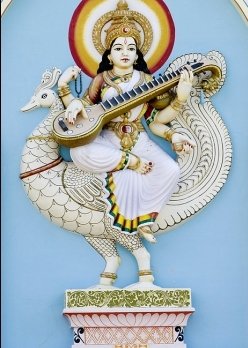
  Prabhupada Padma by Rasa     Following is the translation of ‘Prabhupada Padma’, in glorification of Srila Bhaktisiddhanta Sarasvati Gosvami Maharaja Prabhupada, composed by H.H. Srila Sridhar Gosvami Maharaja. &nbsp 1) His lotus feet are served in devotion by multitudes of high, virtuous souls; he is the establisher of the religion of the age … Read more

Bhagavad Gita, Gauranga.org Articles, Video

The Form of God – Fact or Fancy?

&nbsp

Is God a formless force, or the supreme eternal person?

&nbsp
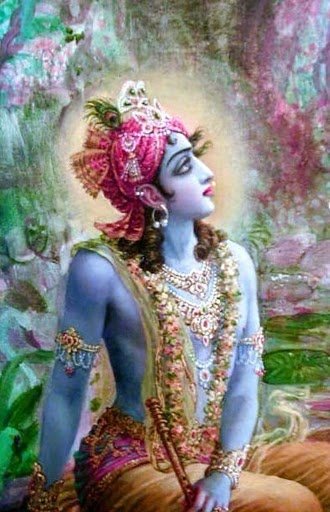
Often people become puzzled when they see a picture of Lord Krishna. Usually they have been exposed only to Western religious philosophy, which hints that God is a person—the eternal father of every living entity—but gives scanty information about His form. For this reason many people think God is formless or void. But by using a little logic we can easily understand that if God is our eternal father, He must have form. Our fathers are persons with form. And if we count back thousands of generations we will find that our forefathers were also persons with form. Why should we think that the original, primeval, absolute father (God) is not a person, or that He is a formless person? The word person implies form; a formless person does not exist.
&nbsp
Nevertheless, many people think that since God is spirit, He must be formless. They consider spirit to be some transparent, ethereal “force.” However, beyond this hazy conception of spirit, which is not upheld in any of the great scriptures of the world, is the scientific explanation of spirit—or, as modern science calls it, antimatter—found in the Vedic literature.
&nbsp

&nbsp

Scroll to Top