The liberation of Aghāsura as well as Brahmā’s bewilderment and subsequent bhāva occurred within the forest not far from the village.
During Kṛṣṇa’s late childhood, he and his friends herded calves close to the village and returned home not too late in the day. However, from the day of Agha’s good fortune, and for one year up to and including Kṛṣṇa’s acceptance of Brahmā’s prayers, Kṛṣṇa and his comrades returned later and later, day by day, a pattern that did not go unnoticed by his parents.
His childhood was nearing its end, his boyhood just beginning. Grantha-rāja Śrīmad Bhāgavatam begins its description of Kṛṣṇa’s paugaṇḍa-līlā with a reference to Gopāṣṭamī—babhūvatus tau paśu-pāla-sammatau—the day on which Rāma and Kṛṣṇa graduated from calf-herding and became fully initiated cow-herders.
The eighth lunar day of the waxing moon in the month of Kārtika—Rādhā’s month—is known by the learned as Gopāṣṭamī. From this day onward, Kṛṣṇa served as a cow-herder, whereas previously he had tended only calves. Kṛṣṇa’s sweet, tender feet, praised by Brahmā, now bore the weight of his boyhood body, and thus they left lotus-like imprints wherever he traversed, blessing Mother Earth with his footprints, showing the way to sakhya-rati—padair vṛndāvanaṁ puṇyam atīva cakratuḥ.
During Kṛṣṇa’s boyhood līlās, Balarāma’s prominence increased, even while Kṛṣṇa’s romantic adolescent sensibilities began to manifest.
Śrī Jīva Goswāmī describes Rāma and Kṛṣṇa’s paugaṇḍa thus: As Kṛṣṇan and Balarāma reached paugaṇḍa, their intelligence increased. The luster of their black and white complexions defeated that of their kumāra period. Their chests expanded, their eyes elongated (toward their ears), and their limbs also became longer. Their hairdos and manner of dressing became more elaborate. They became skillful at learning new varieties of play, and their overall affection increased. So soft is their boyhood as it first emerges. I feel a great longing to see them.
Kṛṣṇa’s kumāra-līlās are enacted from his place of birth, Mahāvana; his paugaṇḍa-līlās from his home, Vṛndāvana; and his kiśora-līlās from Nandagrāma. Just how long his paugaṇḍa, or boyhood, lasts is a matter of opinion, as commentators answer this question differently.
For our purposes, Kṛṣṇa’s boyhood begins with Gopāṣṭamī and ends just prior to his rāsa-līlā with Rādhā. However, his boyhood is essentially shortened with the early dawning of adolescence while he lives with his friends and subsequently becomes acquainted with Śrīdāmā’s sister and those of his other friends.
Līlās characteristic of the paugaṇḍa age include Balarāma’s prowess defeating Dhenuka, Kṛṣṇa’s chastising of Kāliya, the cowherds protected from Kaṁsa’s forest fire, as well as Kṛṣṇa’s pūrva-rāga līlās—youthful, unacknowledged, romantic love in the separation of anticipation.
The days leading to the Gopāṣṭamī celebration caused further tension between sakhya- and vātsalya-rasas, tension that was gradually mitigated by factors such as the assistance of Kṛṣṇa’s uncles, the confidence that Balarāma instilled, the eagerness of the cows to go out with Kṛṣṇa, and astrological calculation. Thus, that which was unthinkable for Yaśodā turned into a mother’s pride for her highly accomplished son.
When Abhinanda’s wife arrived early one morning and, surprised upon not seeing Kṛṣṇa, wondered as to his whereabouts, Yaśodā opened up to her friend about what she perceived as a departure from Kṛṣṇa’s normal behavior.
While up until this point she had daily bathed and dressed her son, now he insisted upon attending to these rituals himself, expressing a measure of embarrassment before her and quickly heading to the cow pens after briefly showing respect to his parents. They were amused by his choice of attire but challenged by his brevity with them.
Rāma acted similarly—both boys were now beyond their mothers’ control, both wanted more than anything else to herd cows. This Yaśodā could surmise, but she remained in denial of it to the amusement of her friends and relatives.
Nanda Rāja began to notice a certain delight among his younger brothers, which they attempted to conceal as he approached. It became apparent to him that Kṛṣṇa was suddenly fond of spending more time with his uncles than with him. This was obviously the cause of their delight, but the reason behind it remained unclear to Nanda.
If Kṛṣṇa was among them when his father approached, the flame of their enthusiastic conversation was quickly extinguished just before Nanda arrived. Among themselves they spoke of cowherding, sharing their own maturation to manhood as herdsmen and thus nourishing Kṛṣṇa’s eagerness for accepting this responsibility.
After some days, Nandana and Sunanda, Nanda’s younger brothers, began to reveal everything to him. They did so skillfully by initially broaching the subject indirectly, speaking of elderly Nanda’s growing need to be relieved from his herdsman responsibilities.
As Nanda ever so slightly acknowledged their concerns for him, this in turn opened the door for them to state the obvious. The glory of his son would be realized only as he took this responsibility upon himself. Indeed, from their perspective, Kṛṣṇa now desired to become a herdsman for this very reason.
His sudden arrival surprised Kīrtidā, who was not expecting her nephew Sudāmā to return so early in the day. Thus she remarked, “O son, I see that you have come hurriedly, the lotus of your face fully blossomed, but you are without Śrīdāmā and have returned so soon from the house of Nanda. Please come; sit. Tell me of the celebration at Nanda’s residence. Its sounds reverberated throughout the Vraja-maṇḍala.”
Sudāmā replied, “O mother, this is the joyful news of today that you alluded to earlier! By the permission of Yaśodā, my dear friend is going to the forest along with Balarāma and our other friends for herding the cows. And just now he is happily coming with his friends to Vṛṣabhānu-pura. Śrīdāmā sent me in advance to inform you so that auspicious preparations for Rāma and Kṛṣṇa’s arrival can be arranged.”
Thus, the kingdom of Vṛṣabhānu was elaborately decorated to honor the arrival of Rāma and Kṛṣṇa.
Śrī Nayanānanda Ṭhākura envisions Vṛṣabhānu-pura in the shape of a thousand-petal lotus flower, extending sixteen miles in circumference. It is dotted with countless cowherd dwellings made of bricks and beautified by various clusters of trees and gardens.
Kṛṣṇa restrained Kīrtidā with hand gestures from giving him seconds, and at that Rāma retorted, “Enough delay, dear friends! I fear that the cows will stray from the path.” But wishing to restrain the boys longer, Kīrtidā pulled Kṛṣṇa aside and said, “O dearmost son of Yaśodā, birth in Vraja, by which your association is attained, is rare, but to have you in my home under the control of Śrīdāmā’s love is exceptionally rare. Today we are experiencing that for the first time. If you please pause long enough to eat something along with your friends, my life will be fulfilled.” Kṛṣṇa replied, “Mother, please consider me as much your son as you do Śrīdāmā. He and I are equals.” Thus Kṛṣṇa and his friends lunched playfully and laughed among themselves to the delight of their many mothers. Kīrtidā then asked Rādhā’s handmaidens where her doe-eyed daughter was on this happy occasion. But try as they did to make excuses for their mistress, Kīrtidā insisted on her presence. Being so informed, Rādhikā spoke aloud, “I have been called by my mother. Hari, Hari! Even if I remain unseen and in hiding, I am not able to stay composed. If I am to go as called for and if he boldly approaches me, surely, I will lose my self-control before that best of cowherd boys in front of all the elders.” To these wise yet shy words, Rādhā’s dāsī Rūpa-mañjarī replied, “Do not fear, dear one. We handmaidens will surround you. And with you protected thus, how will Kṛṣṇa untie himself from the bond of friendship tied by your brother Śrīdāmā and others to act inappropriately before them and their elders? Surely among his closest friends there are some such as Subala who understand the ways of love, offer wise advice, and will thus restrain him. What’s more, if you do not take advantage of this rare opportunity to see him up close, your loss will be inestimable, and regret will color your youth and, by extension, the rest of your long, painful life. Hesitation in the face of auspicious opportunity brings only misfortune. The time is always right to do what is right. Besides, what is supposed to happen will happen. Here, carry these betel leaves and nuts and go quickly surrounded by us, as the cowherds’ lunch is almost over. Once Śrī Balabhadra resounds his horn of thunder, in a flash of lightning this auspicious scene will suddenly end and with it your good fortune.” Her mind changed by these words of wisdom, Rādhikā, surrounded by her kiṅkarīs, brought the pan wrapped in betel leaves on a golden dish. Then, as she beheld the lotus face of Śyāma Hari, he too gazed unblinkingly into her longing eyes as Subala, understanding the situation, gestured and introduced his friend to Rādhā with a whisper: “This matchless beauty standing before you is Śrīdāmā’s sister, born at midday with the blessing of the sun—Mitra, the universal friend—and thus named Rādhā. With the melting of your heart upon seeing her, your complexion is beginning to turn a different shade of śyāma. Surely, she is the girl Sarvajña predicted you would meet today, the love of your life. Fortunately, others will think that your ecstatic symptoms are due to the heat generated by such a large indoor assembly. Hold my hand and dam the tide of the oceanic feelings of love you are experiencing for her in the presence of our elders.” In this way, Subala assisted Kṛṣṇa and Rādhā in their hour of need, following up on his words with hand gestures, eye movements, and humming sounds that only Kṛṣṇa could understand. Then, seeing Hari perspiring profusely, trembling, and appearing helpless—lovestruck in his boyhood by the darśana of the lotus of Śrī Rādhā’s face—Sudāmā thought his condition to be the result of too much heat in the house due to so many people crowded inside. Thus, he started affectionately fanning his friend with the ends of his cloth, saying, “Alas!” Subala intervened. “O brother, not like that. Come, let’s take everyone outside. Kṛṣṇa’s body is very delicate, and he is feeling exhaustion from herding and overcrowding. Let us clear the room, give him some air, and let some delicate young lady whose nature and touch is as soft as dew gently fan him.” At the same time, Rādhā’s kiṅkarīs also began to usher her out of the room, leaving Sudāmā’s sister, Rūpa, to fan Śyāma as instructed by Subala. Then from outside Balarāma’s horn thundered loudly, bringing Kṛṣṇa to his senses. Rāma then engaged his friends in attending to their cows in various ways as Subala escorted Kṛṣṇa back into the circle of his friends. As the young cowherds eagerly prepared to depart, Kīrtidā and Suśīlā implored Rāma to protect their sons, Śrīdāmā and Sudāmā, just as he protects Hari. Balarāma pridefully replied that he would do so. Then he and Kṛṣṇa led their friends into the forest, where the cows simultaneously rushed from all directions, jumping playfully, constantly swirling their tails up high and filling heaven and earth with their mooing. Then, with great force, the cows stampeded toward Kṛṣṇa, stopping suddenly in front of him and then surrounding him, some licking him. Observing this scene, Śrīdāmā spoke thus to Kṛṣṇa: “Dear brother, the cows had become anxious in their brief separation from you.” On hearing these words of Śrīdāmā, Kṛṣṇa smiled charmingly as his herding līlā resumed, led now by Balarāma. Jaya Rāma! Jaya Hari! Jaya Rādhe!
The gopas’ houses are beautified by flags of different colors—white, yellow, red, and blue—arranged in sequence and fluttering in the breeze. The four external walls of each house are draped with forest flower garlands celebrating the four directions. Numerous species of flowers are always in full bloom therein, and there are rows upon rows of campaka flowers and varieties of jasmine, hovered over by maddened honeybees whose sound is very pleasing to the ear.
The cooling breeze, bearing the fragrance of the flowers, blows very gently in all directions. Large lakes and placid ponds remain still, resplendent with many species of lotus flowers. From these lakes and ponds waterfowl sing, while on their shores peacocks dance. The bases of the banyan, fig, and mango are encircled by jewel-studded platforms. Various types of birds such as parrots move about, and some sit among these trees, and there are storks in the tall grasses, where crickets and other insects sing of their own good fortune.
In the center of the town stands the palace of Rāja Vṛṣabhānu, surrounded by a moat. With Rāma and Kṛṣṇa soon arriving, Kīrtidā stood at the door, ārati paraphernalia in her hands, surrounded by young gopīs bearing pitchers of drinking water. The girls’ eyes were fixed ahead on the path on which the boys would soon appear.
Within the palace, Rādhā’s handmaiden Rūpa-mañjarī, who is the personification of Rādhikā’s beauty (rūpa), informed her of the approaching herd of cowherds and their cows, headed by Nanda’s famous son: “O Rādhā, the moon of Gokula is going to ornament the village now!
Behold Hari, dressed as a dancer, his left hand in the hand of brother Śrīdāmā. Hari destroys the dharma of Vraja’s damsels. His hair is decorated with strings of campaka flowers. His chest displays a pearl necklace. An enchanting flute is tucked in his belt, and the sandalwood paste on his blackish body is beautified by his extraordinary luster. In his hand he holds an excellent stick. He is led by Rāma, who is like a mountain of snow, and he is surrounded on all sides by his dear friends. The scene, of which he is the cynosure, looks like a lightning-clad monsoon cloud in the light of the rising moon surrounded by a rainbow.”
Following Śrī Rūpa’s lead, Rādhā peeped through an air hole in the wall intended to provide a cooling breeze, and there she saw Kṛṣṇan and his sakhās, a sight that made her heart melt. Overheated, Rādhā shyly beheld Hari, wrapped in silk that resembled lightning, his contrasting complexion like a dark monsoon rain cloud.
As her heart thundered, torrential rains poured from her eyes and teardrops glistened on the cheeks of her lotus face. His eyes too were lotus-like, his face the best of moons. His palms and the soles of his feet were reddish. The nails on his hands and feet were like rows of stars illuminating his body by their soothing rays.
Infinitely deep was the impression his appearance made on her lovesick heart, even now at the very beginning of Rādhā and Kṛṣṇa’s paugaṇḍa-līlā, long before the consummation of their desires.
As Rāma and Kṛṣṇan arrived, Kīrtidā, Suśīlā, and other mothers welcomed them, “O sons, O Rāma and Mukunda, please come, please come.” Their voices were barely audible over a chorus of “Jaya! Jaya!” that resounded from the mouths of the girls of the community, who sprinkled scented water on the ground before the blessed brothers.
Immersed in an ocean of bliss, the mothers repeatedly cried out “May you live long” while kissing the boys’ cheeks. Suśīlā then offered ārati to Rāma and Kṛṣṇa, who were circled on three sides by sakhās Śrīdāmā, Sudāmā, and Kiṅkiṇi, behind whom the multitude of cowherds sang rasika songs of their own composition in celebration, glorifying cows and the two cowherds Rāma and Govinda. Thus, the home of Kīrtidā and all of Vṛṣabhānu-pura was blessed on this eighth day of the waxing moon in the month of Kārtika.
Once inside, Śrīdāmā requested his mother to offer the intoxicating mādhvī beverage to Bala, explaining that earlier on the path he had secured his visit on the promise of such refreshment. He was confident that this alone would satisfy Rāma and that other delicacies, such as śikhariṇī, should be offered to Kṛṣṇa and his comrades. Balarāma was delighted with Śrīdāmā’s words.
As Kīrtidā gave Rāma a pot of madhu, he glanced playfully at Hari and told him, “Hari, my life, I know that you also desire to enjoy this beverage, but you are too young for that,” and greedily consumed the pot of madhu in front of the assembled cowherds.
Furthermore, it was apparent that as a result of Nanda’s penance in pursuit of conceiving his child, Nārāyaṇa had showered him with his blessing in the form of a skillful son. Kṛṣṇa was in fact what Nanda wanted him to be. Thus, he had no recourse now but to let him be who he was destined to be.
In this way, Nanda Rāja’s thoughts began to change from thinking about Kṛṣṇa as a young child to thinking about his future: a glorious boyhood as a herdsman.
Thus, to date his prowess as the protector of Hari was more the projection of Yaśodā than anything else. And now her own projection that gave him authority in her mind and his came to haunt her. At the same time, her projection proved accurate, for in the Bhāgavata, Śukadeva has said as much and more about Baladeva as his boyhood matured: The whole of the universe rests on Rāma as a woven cloth rests on its warp and weft.
Rāma bowed before his mothers and then stood next to Kṛṣṇa, with their cowherd friends flanking them on one side, Rohiṇī and Yaśodā on the other. Then he solemnly announced, “Mother, today Kṛṣṇa should go to the forest with me and herd cows. Do not be afraid for him. Who can possibly harm him in my presence?
From the distant stars in the sky to the ground beneath our feet, and from the eastern sunrise to the western sunset and every direction in between, there is no one who can defeat me.”
Led by Śrīdāmā and Sudāmā, the boys cautiously approached. They held flutes and herding sticks and were wrapped in beautifully dyed, variously colored cloths tied close to their waists with decorative belts, each boy’s hair tied in a topknot. And on their faces they wore suspicious, barely discernable smiles, which they further concealed by lowering their heads, unsure of the outcome ahead.
Looking at them as they stood sheepishly before her, Yaśodā spoke to all of them by addressing their leader, Śrīdāmā: “O son of Vṛṣabhānu, what do you have to tell me regarding the rumors I’m hearing about all of you boys? O my dear child, in Vraja-maṇḍala you are an abode of prema and as praiseworthy as Hari himself. How is it that you have come to my house with the intention of taking my child deep into the forests of Vraja, herding full-grown cows?
Hearing this, the chorus of cowherd boys raised their arms above their heads and spontaneously chanted “Rāma Rāma mahā-bāho!” with such force and feeling that any remaining opposition to their desire to herd cows with Kṛṣṇa resembled only the final moments of a sporting event whose outcome has already been decided.
Then, stunned and barely able to collect herself in the face of such insurmountable odds, the best of mothers multiplied by millions replied, “O mighty Balabhadra—Father—what you wish will certainly come to pass.” But once she had appropriately addressed the elder brother as “father,” her own husband came to mind. As if now prepared to assist in dispensing with any remaining obstruction, she added, “Still, we would be remiss not to ask for the consent of Śrī Vraja-pati. Let us wait for him to arrive.”
Meanwhile, Vraja-pati Nanda was on his way back from the milking parlor along with other elder gopas. Their conversation centered on the temperament of the cows—their unwillingness to milk or move without Kṛṣṇa’s direct involvement—and how Kṛṣṇa himself and his friends under his direction had risen to the occasion by milking and pasturing the lactating cows.
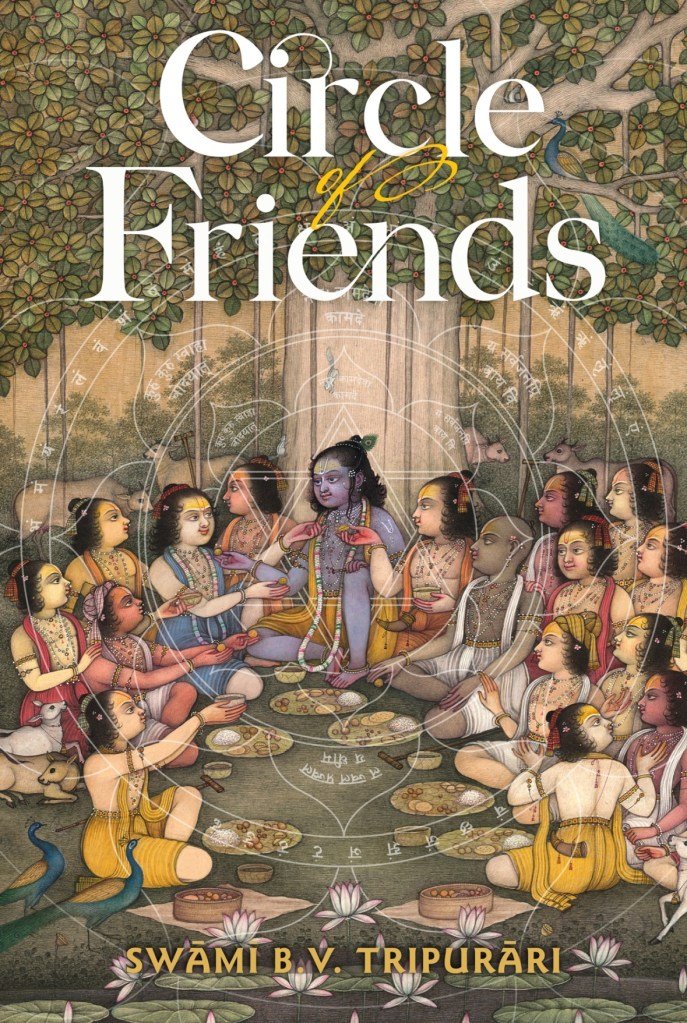
Yaśodā told Śrīdāmā to stand in front (west) of her sons, Sudāmā to their right (north), Vasudāmā behind them (east), and Kiṅkiṇi to their left (south). Upon the eight meditative petals, she placed Stokakṛṣṇa, Aṁśuka, Bhadrasena, Arjuna, Subala, Vilāsa, Mahābala, and Vṛṣabha.
These boys were then further surrounded by millions of sakhās, who in turn were surrounded by hundreds of millions of cows. May the sakhya-rati-upāsakas’ mantra-mayī-upāsanā take on a life of its own, as the deep lake of their fixed meditation begins to spontaneously flow—svārasikī—like a river of herding līlās in all directions.
Then, offering foot wash and arghya to the cows, feeding them sweet chickpeas, respecting them with praṇāmas and circumambulating them, Rāma and Kṛṣṇa began to herd the cows.
However, with Kṛṣṇa behind them, the cows refused to go forward. Instead, they turned around to face him. Thus he reversed course and again went behind them, calling for them to proceed. But they again turned to face him.
This circular motion continued for some time until Kṛṣṇa led them into the forest, gradually moving backward into the herd and surrounded by it and eventually ending up behind it. From there, he continued to herd them forward.
Then the cows, secure in their understanding that Kṛṣṇa was among them, appearing to them as if he were in front, behind, and on all sides of them at once, raised their tails and began to dance and prance, kicking their hind legs high toward the sky while also mooing in ecstasy.
As they proceeded in the direction of Mount Govardhana, the gopas herded their cows by uttering unique sounds and never using their sticks to prod them. It was as if the boys and cows spoke the same language. And Kṛṣṇa increased the cows’ bliss by composing cowherd songs, which is a trait particular to gopas such as himself.
To the devas it appeared that when the cows were happy, Kṛṣṇa was happy. When the cows were satisfied, Kṛṣṇa was satisfied, and when they were hungry, he experienced hunger. He brought them close to his chest, smelled them, embraced them, searched for them, collected them together, fed them, and protected them. Kṛṣṇa considered the cows to be as dear as his life, and without him they became disheartened and motionless like two-dimensional paintings. When they came close to Kṛṣṇa, they experienced bliss on smelling, seeing, hearing, tasting, and touching him. Thus, it is no wonder that go-sevā is an aṅga of bhakti!
Gradually the herd and young herdsmen disappeared from the sight of the villagers, who had climbed up onto their rooftops in the hope of keeping Kṛṣṇa in view.
Then Śrīdāmā-sakhā placed a respectful request before Śrī Kṛṣṇa: None of those led by your mother were able to keep you from going to the forest, even as they called from their rooftops, “O son of Gokula’s Nanda, O lotus of our community.”
O friend, if you accept, then let me make a suggestion. Although it is some distance from here, my mother also desires to see you in our house. Indeed, she only gave me permission to herd cows in the hopes that at some point as we wander throughout the forests of Vraja I would bring you, Rāma, and our friends to Vṛṣabhānu-pura. Let us go all the way to Vṛṣabhānu-pura and extend our play there. Please consider this request.
In the above description adapted from Govinda-vallabha-nāṭaka, the drama’s author, Dvārakānātha Ṭhākura, envisions himself as a sakhā and resident of Vṛṣabhānu-pura. As he writes, he desires to invite Kṛṣṇa to his village and does so through the voice of Śrīdāmā. However, his pen reveals an element of respect within his budding sakhya-rati, as Śrīdāmā respectfully requests Kṛṣṇa to “please consider this request.”
Then, from within the Ṭhākura’s heart, assuring him of the intimacy central to sakhya-rati, and dispensing with any hesitancy or respect that would create distance and cause Dvārakānātha’s sakhya-rati to contract, Kṛṣṇa says to Śrīdāmā: O friend, know that I have the same strong constant love for all of you that you have for me.
Because of your words, I disregarded even my mother’s instruction earlier today and went off to the forest. I am like a boat, and all of you, dear one, are like the best of boatmen. Wherever you wish to take me, I will go there without hesitation. It is not appropriate for you to speak to me with respect. We are equals. We will go. Let us go. Let’s definitely go to your village.
Then Baladeva interjected and asked what Śrīdāmā had requested of Kṛṣṇan and where they were taking the sakhās and their cows. In reply, Śrīdāmā told Rāma that they would now go to Vṛṣabhānu-pura. And to secure his willingness as well, he suggested that once there, his mother, Kīrtidā, might give Rāma the delightful and intoxicating mādhvī beverage.
Given Rāma’s penchant for such beverages, this piqued his curiosity. As the boys approached Vṛṣabhānu-pura, from a distance they could see its skyline beautified by large houses made of crystal and other similar stone, demarked by various colorful flags resting on the roofs.
They saw rows of large ponds ornamented by groups of lotus flowers—yellow, red, white, pink, and blue—encircled by swarms of swirling honeybees, their pleasant buzzing accompanied by the sounds of the sporting swans and other waterfowl. The town was also beautified by gardens overflowing with a wide variety of blooming flowers. Śrīdāmā then told Sudāmā to go ahead of the others, bearing the news of their imminent arrival with Rāma and Kṛṣṇa.
He thus approached with amazement and also pride in his son’s abilities. Earrings swung from his ears, and his forehead was adorned with vertical tilaka. In the morning sun, his complexion appeared to vacillate in color between that of a pinkish conch shell and a darker shade of sandalwood paste. His protuberant belly indicated a long and satisfying life, as did his salt-and-pepper beard. Wrapped in silk, in his hand he held a goad, and on his feet he sported fragrant fine-grained sandalwood shoes.
As he arrived, he offered a blessing, causing some commotion: “May Kṛṣṇa bless you!” Smiles immediately spread across the faces of the young gopas, some of whom nudged one another, finding Nanda’s blessing humorous.
Noticing this, Nanda schooled them all. “Boys—Śrīdāmā, Sudāmā, Subala, Aṁśu, Stoka, Suvākya, and all of you gathered here—I have invoked the blessings of him after whom my son is named. Do you not know the virtue of naming one’s son after Bhagavān?”
As the boys sobered, ready to be schooled, Nanda, drawing upon the Purāṇic lore, told them at length about the amazing story of an ancient brāhmaṇa—Ajāmila—who named his son “Nārāyaṇa.” Although Ajāmila was impious and involved with a prostitute, having called out his son’s name at the time of death he was delivered by the messengers of Viṣṇu.
Thus Nanda extolled the virtues of śrī nāma, fascinating while also edifying the young gopas.
Then, as soon as Gopa-rāja Nanda finished the narrative, the boys spontaneously began to chant, “Jaya Rāma! Jaya Kṛṣṇa!” dancing as they did so. And then, along with Rāma and Kṛṣṇa, they bowed before Nanda Bābā, some saying affectionately, “By your mercy we are extremely happy,” while others simply nodded in affirmation, all of them waiting now for Nanda’s final approval of their plans.
Thus the scene slowly returned to normal yet remained surcharged from the Purāṇic wisdom and subsequent nāma-kīrtana.
Yaśodā then ventured to focus her husband on the pressing concern of the hour. “These cowherd boys assembled in the courtyard want to take Hari to the forest for herding cows, and he desires the same. Their enthusiasm appears uncheckable, and to my astonishment they have also reasoned well in support of their desire. Furthermore, Rāma has given his consent. O Vraja-pati, I place this matter at your feet. What is your opinion?”
Gopa-rāja Nanda replied, “O Goṣṭharānī, we have discussed this earlier in private with no resolution, but in consultation with my brothers and in consideration of the latest development with our herd, I have reached a conclusion.
Now even the cows are calling for this. Such is their love for our son! Furthermore, while Govinda is still very young, I am quite old. Nārāyaṇa blessed us with a son in our latter years. Thus, his youth corresponds with my age such that it mandates he take responsibility for the herd at an otherwise early age as I move toward retirement. And for that matter, it appears that his friends similar in age have already received permission from their fathers to herd cows.
Thus, it appears now to be the norm in our cowherd community, and my mind has turned from fearful for his sake to proud of his boyhood maturity. If he is capable of relieving the burden of his aging father, then that is something to rejoice in. My birth has now attained its fruit. This is my conclusion.”
Then, placing Hari on his lap, his hand on his son’s back, Nanda asked him, “Govinda, are you capable of herding the cows in the very frightful forest?”
Govinda: Father, I am capable if I am accompanied by my elder brother Balarāma.
Nanda Bābā: But some will say that you have not yet reached the appropriate age.
Govinda: Then how is it that the boys my age from well-to-do families, Śrīdāmā and others, have been granted permission to herd?
Nanda Bābā: Well said, son. What remains now is only to call an astrologer and determine the auspicious moment to celebrate and proceed.
Thus, Nanda called for a wise astrologer who could ascertain the past, present, and future, being adept not only in reading his child’s natal chart—subject to any number of interpretations—but also in meditation and spiritual practice.
And within moments, the very short, old, shaking, and disheveled Sarvajña arrived, wearing a thick sacred thread under loosely wrapped cloth, his face smiling pleasantly. His complexion was dark yet lustrous, and his forehead was adorned with thickly applied tilaka from the mud of the Yamunā, as were his arms and torso. He was talkative, while appearing to be residing in the heavens above. And speaking from there, he offered his blessing to the cowherd king: “May the Sun expand your power and health; the Moon your beauty and mental serenity; Mars your prosperity; Mercury your mercantile intelligence; Jupiter your spiritual knowledge of the scriptures; Venus the incomparable ability to compose poetry; and may Saturn, Rāhu, and Ketu continually effect the harm of your enemies. All glories to the king! What is your order?”
Śrī Nanda replied, “O Cakravartin, today Kṛṣṇa wants to go to the forest for herding cows. Therefore, please tell us if this eighth day of the bright fortnight of Kārtika aligns with his desire.”
However, Sarvajña replied as if he had not heard the king’s request, which the king then placed before him once again, only to realize in due course that the jyotiṣa was hard of hearing.
Indeed, the king next asked him if he was deaf, to which Sarvajña replied, “What? Please speak loudly.” Nanda asked again, almost shouting, but to no avail. Thus, he turned the task over to the assembled cowherd boys, who in unison asked him the same question simultaneously in both of the astrologer’s ears.
However, Sarvajña only asked them to please speak louder. Thus, they moved closer to his ears as if to whisper and widened his ears’ openings with their hands while shouting out the same question.
“Ah, understood. You are asking about the day of Baladeva’s marriage, because on the marriage of the elder there is then the chance of marriage of the younger,” Sarvajña replied.
This in turn greatly frustrated Balarāma, who sounded out the same question with volume comparable to that of the deafening thunder following a nearby lightning strike. With this, he finally got through, and the eccentric jyotiṣa replied, “Ah, you want to know an auspicious day for the king’s son to begin herding cows.”
With his response, the assembly of cowherds was overjoyed with relief that quickly turned to apprehension as to what reading he would arrive at.
However, as if he knew all along, he replied immediately and directly to the king with praise for this very day itself: “O virtuous king of Vraja, what can I say about the glory of this day—the lunar day of the waxing moon in the Kārtika month during the śravaṇa constellation on a Wednesday?
On hearing of this day, the wise derive pleasure with regard to herding. The stars are auspicious, the day of the week and the date are auspicious, the yoga with the karaṇa is auspicious in the lagna, and all the planets speak to us of their pleasure concerning the proposed journey your son desires to embark upon.
Furthermore, O king, long life span, destruction of enemies, fame, eloquence, and intellect all come to one who travels on this day. Indeed, it would be difficult to find a more auspicious day.”
With this, Sarvajña then smiled brightly, his wise eyes twinkling like stars lighting the night sky of his otherwise concealed meditative mind, as he motioned for Kṛṣṇa to come near.
Then he spoke ever so softly into Hari’s right ear: “Above all, on this journey today, you with a complexion bearing resemblance to the effulgence of a dark sapphire (nīlamaṇi) will also glimpse the brightest (ujjvala) form of the Goddess who will become the lady of your life.
The beauty of all the women in all the worlds combined—earthly, heavenly, and even that of the great Goddess of good fortune herself—cannot compare to even the reflection of the rays emanating from her toenails.”
Kṛṣṇa, blushing, his heart beating rapidly, replied, “What did you say?” as the cowherds raucously celebrated Sarvajña’s response to the king. Only Subala heard the beat of Hari’s heart, muffled by the closure of his lotus eyes.
Thus, Nanda Mahārāja called for a festival, and word quickly spread to all corners of Vraja, heralded as it was with kettledrums and callers. Resident sages, brāhmaṇas, singers, dancers, and other artisans all assembled, as did men, women, and children from all sections of society.
On Nanda Rāja’s order, bards composed and recited the history of all that led to this event. Singers sang songs of their own composition in praise of herds, herdsmen, and Hari, as dancers danced in time, depicting herding and satisfied cows through their steps.
Somehow the festival that followed lasted forever, while not delaying Kṛṣṇan and his cowherd friends from departing at the auspicious moment.
Elder gopīs blessed Yaśodā’s son with a long life as they sprinkled grains and dūrvā grass on Hari’s head and kissed his lotus face.
Highly qualified sages wearing tulasī buds strung together in garlands bore waterpots containing water from all of the sacred rivers of Bhārata and sang hymns from the Sāma Veda. Thus they looked as brilliant as the sun, their hair woven together in matted locks turned golden from its rays.
The sages’ concern was to shed light on Gopāla—Gopāla tāpanī—who was the only object of their inner life and whose dark complexion, shrouded in mystery, resembled the nourishing prospect of the dark rain cloud.
Seeing the object of their meditation before them, they wept rivers of tears, only to lose sight of him, resorting then again to their minds’ eyes.
And the brāhmaṇas chanted, “Victory to Nanda and his nandana! Victory to Gokula and its beloved Gokulānanda!”
In response, Nanda and Yaśodā rose and then bowed to the brāhmaṇas, placing the dust from the brāhmaṇas’ feet on Kṛṣṇa’s head.
Then the elder and younger gopas along with their family members offered respects to the king of Gokula and chanted, “May your Kṛṣṇa live long!”
After this, drums resounded and wind instruments were played by experts, pleasing everyone. When the music stopped, the jyotiṣa announced, “O King, the lagna for the journey has arrived.”
Then Rāma blew his horn, the sound of which reverberated throughout the universe. Following Rāma’s lead, the young gopas responded with a symphony of their own. They blew horns and played various drums and other types of percussion instruments, such as small cup-shaped hand cymbals (mañjīra).
Some played single-stringed mouth harps (murchunga), while others made musical sounds by cupping their hands to their mouths to create wind instruments.
Others played various flutes, such as the very short six-holed veṇu, the very long four-holed muralī with an open end, and the mid-sized nine-holed vaṁśī, all of which were made from either bamboo or stone.
Still others played stringed instruments such as the tambura and vīṇā, and all of this in an array of melodic structures with musical motifs—rāgas—capable of coloring the mind and influencing the emotions of the audience with the gopas’ own rati. Enthused by the tumult, the gopas danced to their music-making along with Bala and Kṛṣṇa.
The sakhās were decorated in stunning fashion with a variety of peacock feathers, necklaces, swinging jeweled earrings, and beautiful jeweled ankle bracelets bearing small tinkling bells.
Beautiful also were the locks of hair falling on their foreheads, their topknots towering upward like trees bound at the base with flower wreaths, and their long streams of hair cascading over their well-structured bones—the riverbed of their backs. Their forms were breathtakingly beautiful and dressed in a manner capable of captivating the universal mind.
If that weren’t enough, their dancing, music, and merrymaking were accompanied by the unparalleled singing of the gopīs sitting wide-eyed nearby. Repeatedly the gopīs ululated, bringing attention to the scene that none could escape, nor would anyone want to.
Even the birds flying overhead were stunned, and their frozen formation appeared like flowers growing from the ground of the sky, the world turned upside down. The gods gave charity and the sun forgot to move ahead, as all moving and nonmoving beings traded positions.
O residents of Vraja, how the sight of these mysterious boys must delight! A soothing ointment for the eyes, to see them. When will that day be mine? Thus, Gopa-rāja Nanda and Yaśodārāṇī blessed Kṛṣṇa to begin herding cows.
Śrī Jīva Goswāmī comments, If each and every speaker’s mouth became ten thousand mouths and their lives lasted a thousand years, they could at best describe but one day of Kṛṣṇa’s herding. After all, there is considerable mystery surrounding cows, as Go-sūkta states: Sacrifices take place because of cows. The devas appear because of cows. The Vedas, with their six aṅgas, appear because of cows.
Equipped with jewel-studded herding sticks, Rāma and Kṛṣṇa, their foreheads decorated with tilaka, set out to herd their father’s cows.
Although some tension between their parents’ love and their friends’ love remained, it was eased in Nanda’s mind by his cows, whose parental love would accompany the boys.
Nevertheless, Yaśodā ordered Kṛṣṇa’s friends to surround him in a protective maṇḍala that serves sādhakas as a yogapīṭha, or central meditative altar, out of which Kṛṣṇa’s sakhya-rati-līlās unfold.
Imagine an eight-petal lotus within a hexagon that has four perimeter gates where four different desire trees stand. In the center, facing east, stands Kṛṣṇa with Balarāma on his right, both of them arising out of the mantric kāma-bīja—klīṁ—which fulfills all spiritual desires, sva-sādhya.
Then a most auspicious day arrived unbeknown to everyone but nonetheless evident in the spirit of Kṛṣṇa’s friends. When they arrived at Nanda-grāma as usual, there was a spontaneous determination in the air among them: today they would herd cows with Rāma and Kṛṣṇa.
Balarāma, who had been awake with anticipation long before dawn, approved of this shared ambition. By now Rāma had attained a definite sense of leadership among the young gopas that had begun to manifest as a result of contemplating all that had occurred in his absence, starting from the liberation of Agha and ending with the epiphany and prayers of Brahmā. He developed, that is, a sense of responsibility for all of them and for Kṛṣṇa in particular that peaked on this day, at this very hour—the break of dawn.
The young sun, now rising from its bed of the eastern horizon to the chirping of birds, was about to begin wandering with its rays through the sky, illuminating the cowherd kingdom. Similarly, Kṛṣṇa, the uncaused cause behind nature, rose from his bed to the clamor of his friends, who called upon him to wander with cows throughout the forests of Vraja, shedding a light of certainty on the perpetuity of the clan of cowherds and their dharma of go-sevā.
Is Hari only the object of your affection and not that of others such as ourselves? We do not consider him to be separate from our own prāṇa. He is the object of our sakhya praṇaya. And when he is with us, we also become his life airs. How can there be any danger in such an abode of friendship? And in our herding, Rāma will lead us. Who among the evil-minded are not afraid of him—Rohiṇī-nandana? What brought him here in Rohiṇī’s womb on a dark mare in the night? Surely not fear of Kaṁsa, but rather his love for your dark son—Śyāmasundara.
Do you not remember how Rāma was as if lame, deaf, dumb, blind, and practically unconscious in his infancy until he was placed on your lap and close to the love of his life within your holy womb? Who loves Kṛṣṇa more than Balarāma does, and what is the strength of his arms? And who will dare to challenge us in the presence of our friend Maṇḍalībhadra, wielding as he does his bright, rounded sword?
Indeed, thousands of such cowherds will surround the moon of Gokula like the brightest of stars in the sky of Vṛndāvana, which gives only happiness—Sukhadavana.
Fear not, O queen of Vraja! In Vṛndāvana, there are no trees that do not bear flowers, if not fruits, and the flowers’ fragrance is carried throughout the day by the forest’s cool breezes, while at night Vṛndāvana’s aromatic jasmine blooms. Vṛndāvana’s fruits drip with nectar as they fall from the trees, as if offering themselves to Vraja-pati’s prince, while the birds perched on the trees’ limbs create a symphony of melodious sounds to which herds of various colored deer dance. I swear that going there, one never thinks of returning.
Then suddenly, as if summoned by Śrīdāmā’s love, the suhṛt son of Rohiṇī, ruby earring dangling from one ear, the other decorated with a blossoming karṇikāra flower, entered the room bearing his buffalo horn, beautiful Rohiṇī behind him. He swayed into the room like an intoxicated elephant whose footsteps shook the earth beneath them, causing Yaśodā to think that should he approve Kṛṣṇa’s desire for cowherding, how would it be possible to refuse?
At this age, Balavīra began taking himself seriously in his role as the maryādā-puruṣa in Kṛṣṇa’s life, a role largely foisted upon him by Yaśodā. After all, he was Kṛṣṇa’s elder brother by only eight days. And was he actually stronger? If so, to date he had not really proved it. Where was he when Bakāsura, Vatsāsura, and Aghāsura all attempted to slay Rāmānuja?
“Mother, the family of Vṛṣabhānu is as wealthy and prestigious as ours. But despite our wealth and cowherd royalty, I am still a cowherd boy like Śrīdāmā. Our ābhīra dharma is protecting the cows, who are our wealth, just as reciting the Vedas is the dharma of the brāhmaṇas. Do brāhmaṇa boys themselves recite, or do they have their assistants do it? And because we are cow-herders, like the cows we too are curious. How can one’s nature be ignored?”
Astonished, Yaśodā thought to herself, “This son of mine is very expertly instructing about dharma, speaking like an ancient sage although only a child!”
Śrīdāmā then took advantage of Yaśodā’s amazement and spoke boldly to her in vīra-rasa, playfully emboldened by Kṛṣṇa’s nod and glance.
As she spoke, Kṛṣṇa’s friends—Śrīdāmā, Dāmā, Vasudāmā, Kiṅkiṇi, Stokakṛṣṇa, Ujjvala, Subala, Atibala, Suniṣṭha, and others—stood at the door within earshot, dressed and ready to herd. Startled by their appearance, she called them, her voice full of affection: “O gopas, why do you stand at the door? Don’t be afraid of me. Come over here. I want to ask you about something.”
What is the value of taking the wealth of our lives, the cows, who so love the pasture grass we provide, into the dense, dark forests?” Śrīdāmā replied, “Cows are by nature curious. This is not our fault. If their appetite for curiosity and exploration is not fed, they will be restless and difficult to control. I have learned this from my elders. If it were not for this, surely, we would all be content to remain at home.”
Then, casting a sidelong glance upon Kṛṣṇa as a signal for help, Sudāmā interjected, speaking to Śrīdāmā: “Śrīdāmā, Hari is now in his own home with his mother. Let him play here. But we are sons of cowherd men and have no purpose here as the day moves forward. Let us go and take care of the cows, who consider the forest an abode of happiness.”
Understanding his cue, Kṛṣṇa made subtle gestures to his comrades, indicating that he would take it from here.
Today Kṛṣṇa would become a cow-herder! O dear friend, wake up, wake up! O moon of Gokula. The moon with faults, ashamed of your beauty, has departed. And as the morning birds sing, “Victory to the dawn, heralder of the sun,” victory, too, to you, O son of Nanda. The cows await you.
Indeed, on this day the cows curiously refused to let down their milk, much less budge from their pens to their pasture. Somehow it became clear that without the lead of Gopāla Kṛṣṇa, they would do neither. This was brought to Nanda Rāja’s attention, who hurried to the cow pens as if hightailing like a herd bull, energized as he was by this news and his newfound joy in the conviction that the time had come for Kṛṣṇa to herd his cows.
Meanwhile, Kṛṣṇa’s priya-sakhās, themselves eager to herd, insisted that they forgo their morning exercise and athletics in the courtyard and proceed with speed to the milking shed. Once there, Kṛṣṇa approached a seasoned and steady white cow and proceeded to milk her just as he had seen his elders do. Placing the pail between his legs after allowing her calf to drink, he milked her as though he had performed this sevā every day of his life. Lost at sea in a milk ocean of ecstasy, he and his friends milked out the entire herd and sent them out into a corralled pasture.
They then discussed the still-unresolved concerns of Rohiṇī and Yaśodā and spoke excitedly among one another about exploring much deeper into Vraja’s forests than they had to date, determined to prove their competence and thus dispel their mothers’ concerns.
However, upon arriving back home, Kṛṣṇa, dispensing with any and all preplanned tact, simply blurted out with great emotion, “Mother, today I will herd the cows throughout the forests of Vraja.” She replied, “Son, your father owns more than nine hundred thousand cows, and under his expert management, many assistants are engaged and well paid.
You are the only son of a king, not an ordinary cow-herder, and thus there is no need for you to take up such laborious duties, glorious as they may be, what to speak of wandering throughout the deep, dark, and dangerous forests of Vraja!”
As if Kṛṣṇa was Prince Siddhartha, Yaśodārāṇī desired to keep her son within the confines of her cowherd palace and curtail even his calf-herding, lest he opt, as now seemed ever more likely, for a life in the forest. What would that lead to? Nirvāṇa is nowhere! But while Kṛṣṇa had no interest in nirvāṇa, he could not live without (nir) the forest (vana) of Vṛndāvana. Oh, if only Buddha with all of his wisdom had become a cowherd!
(This excerpt of sakhya-rasa pastimes is not complete. It is from ‘Circle of Friends’ by H.H. Tripurary Swami).